Abandoned Apartment
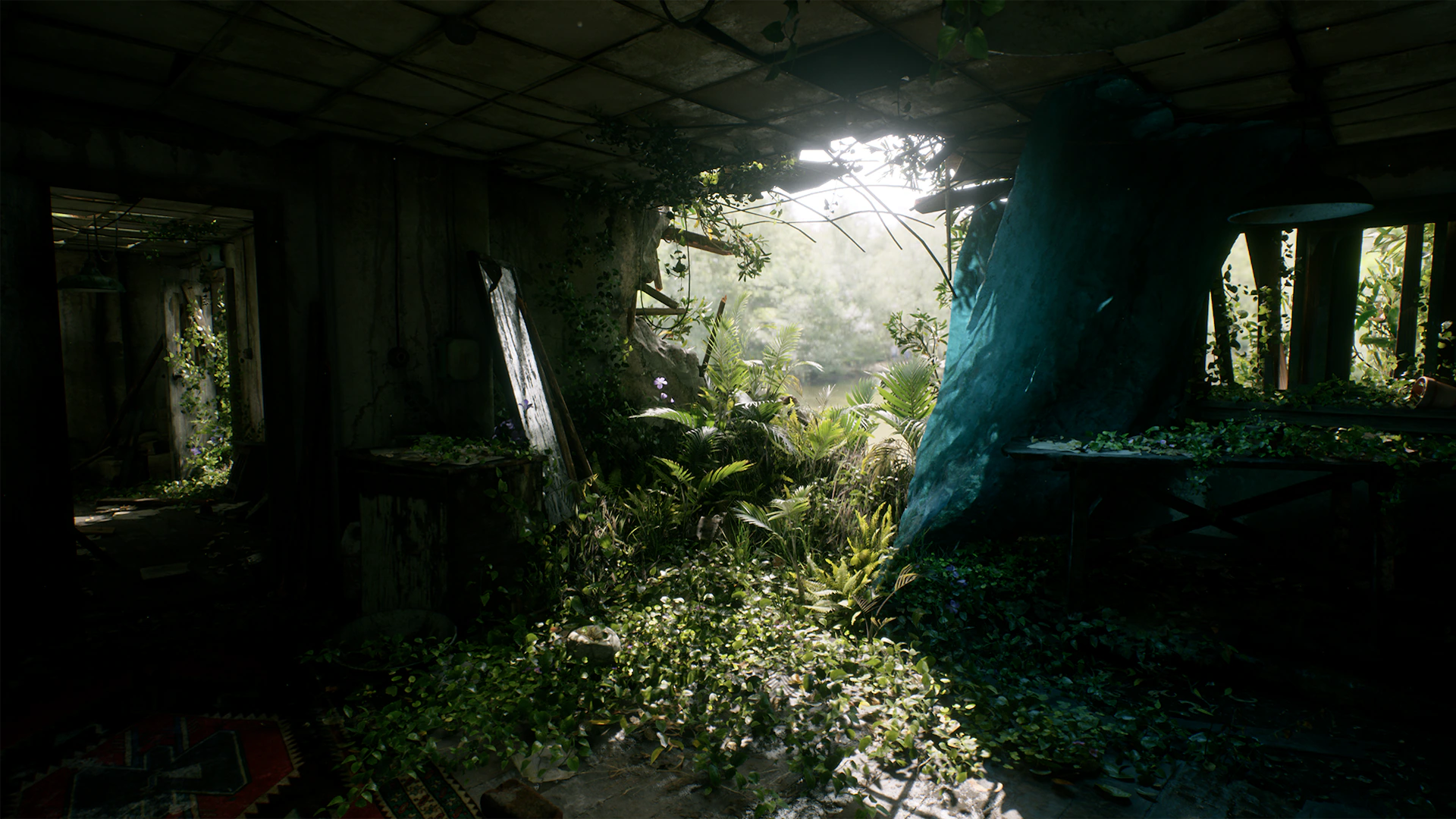
Almost every surface visible here is lit by bounce rather than by the sun directly. That is what makes interiors the honest test of a GI solution.
Download
Why interiors
An interior is almost entirely indirect light. Sun enters through a small number of openings and everything else the eye sees is bounce. Get the GI wrong and the scene reads as flat or as leaking; there is no direct lighting to hide behind.
That makes scenes like this the right place to evaluate the practical differences between Vite's GI options:
Approach | Behaviour in an interior |
|---|---|
Baked probe data. Cheapest, and correct if nothing moves. | |
Probes update at runtime. Handles time of day and moving occluders. | |
Adds contact-scale detail the probe grid cannot resolve | |
Per-pixel ray-traced GI | Reference quality, unaffordable at frame rate, and compiled out by default |
The realistic answer for most interiors is DDGI plus SSGI. DDGI supplies the low-frequency bounce and SSGI fills in the detail near contacts and in corners. See Global Illumination.
What to look at
Light leaking. Probe-based GI leaks through thin geometry when probe spacing is too coarse relative to wall thickness. Interiors are full of thin walls, so this is where to tune probe density.
Corner darkening. Compare DDGI alone against DDGI with SSGI enabled. The difference concentrates in corners and at contacts.
Ambient occlusion choice. HBAO+ versus the optimised SSAO path is most visible in cluttered interiors.
Ray-traced reflections. Interior surfaces reflect a great deal of off-screen geometry, which is exactly the case screen-space reflections cannot handle.