400 Characters CMC Bench
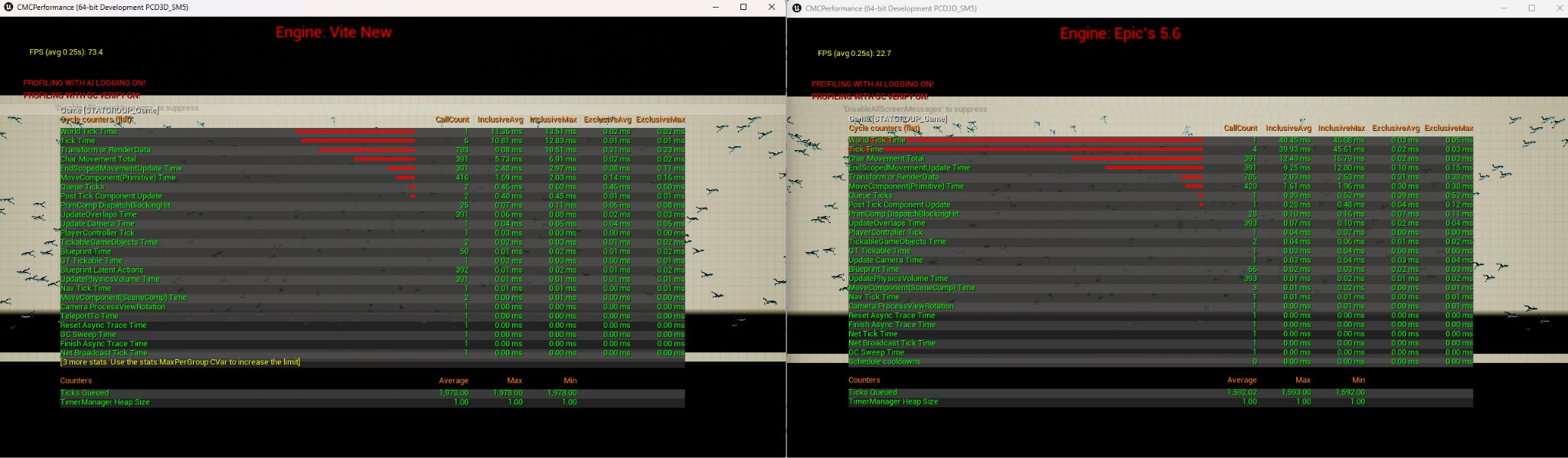
The same 400-character scene on the same hardware. Vite (left) 73.4 FPS, Unreal Engine 5.6 (right) 22.7 FPS. World Tick 11.56 ms against 40.45 ms; Char Movement Total 5.73 ms against 12.49 ms.
Download
What it measures
The Character Movement Component is one of the most expensive stock Unreal components per instance. Every moving character runs collision sweeps, floor checks, root motion evaluation and network-prediction bookkeeping every tick, on the game thread.
At one character it is invisible. At 400 it is often the entire frame budget, and it is the reason so many projects hit a game thread wall long before their GPU is saturated.
This benchmark exists to make that cost measurable rather than theoretical.
Running it
Enable stat unit and watch Game rather than Frame. If Game is the largest number, you are CPU-bound on the game thread and no amount of rendering optimisation will help.
Then narrow it down:
Command | Shows |
|---|---|
| Game thread breakdown by category |
| Character movement specifics |
| Animation evaluation cost, usually the second contributor |
| Collision query cost from movement sweeps |
See Profiling.
Why it matters for Vite
Game thread cost is where UE 4.27 has a structural advantage over UE5, and it is central to Vite's rationale. The base cost of core classes, the tick pipeline and the movement component are all lighter in 4.27, and Vite trims them further — see Engine Defaults for the specific changes.
The relevant comparison numbers are in UE4 versus UE5 Cost Analysis.
Reducing CMC cost in your own project
If this benchmark's shape matches your bottleneck:
Tick less. Distant or off-screen characters do not need full-rate movement. Significance Manager and tick interval both apply.
Simplify collision. Movement sweeps cost in proportion to collision complexity.
Budget animation. The Animation Budget Allocator plugin is stock 4.27 and directly targets this.
Consider not using CMC. For crowds that do not need networked prediction, a simpler custom movement path avoids most of the cost.
Consider ECS. For very large entity counts, the bundled Flecs ECS integration sidesteps actor-per-entity overhead entirely.